
From a recent review of this book (see Blog Post Title), I have a question: Main Question: Is it more efficient to build the indexes in support of invisible keys or to store this same data in each row of a set of tables? What is an Invisible Key? A row of data must haveContinue reading “On Conceptual Modeling: 1984; Brodie, Mylopolous, Schmidt”
Category Archives: Relationship
Hello World! Thank You, World!
I’ve been writing random and sometimes organized thoughts in this blog for quite a while now and I just took a closer look at the statistics of people who have read my stuff. So, I want to Thank every one of you who have read my materials and I hope that you all continue toContinue reading “Hello World! Thank You, World!”
The Data Manifesto
All Data Are Protected (ala The Matrix) An Event occurs that is associated with a collection of data attributes that need protection. Each unique Event has a finite list of Data that are expected to occur when a new instance of an Event happens. In almost all cases, that list of Data includes, at least,Continue reading “The Data Manifesto”
What do seven Y’s spell??
REQUIREMENTS! When someone tells you they have a need, you should be able to investigate that original statement with about seven (7) Why’s before they get bored or frustrated with your interest. I need a daily spending report! Why Daily? Why only spending? Why only ONE day? Why not a Rolling Daily Report of 5Continue reading “What do seven Y’s spell??”
What Users Say Translated to Software Engineering!
I need a report that shows me how much I spent yesterday! Not an atypical ‘requirement’ from a business users’ point of view, huh? What do you as a Software Engineer DO with this and similar statements? Let’s start with a couple of questions that we can use to expand and clarify on a statementContinue reading “What Users Say Translated to Software Engineering!”
The First 90 Days
When I have been asked what I would do in the first 90 days of a new project as the Project Manager, my responses have typically included some or all of the following as a “Self-Orientation Start Up Plan”: 1) Gather the latest project documentation available from the following sources: a) Portfolio Management files forContinue reading “The First 90 Days”
Orthogonal Views…
A current definition provides us this: or·thog·o·nal [awr-thog-uh-nl] adjective 1. Mathematics . a. Also, orthographic. pertaining to or involving right angles or perpendiculars: an orthogonal projection. b. (of a system of real functions) defined so that the integral of the product of any Continue reading “Orthogonal Views…”
Remember Codd and Date?
These were two technology authors who were quoted on the subject of Relational Integrity and a Normalized Data Model. Their ideas of reducing redundancy in the physical data schema and protecting the mandatory relationships between entities took a whole lot of attention about how to create, define, and manage data so that it was safeContinue reading “Remember Codd and Date?”
Input – Process – Output
What exactly should a computer program do? How will you know if the program you have written or requested to be written for you does what you need it to do? It’s really a whole lot simpler than you might think. If you, as a business user, can define what information is available to accomplishContinue reading “Input – Process – Output”
Syntax of an ERD – Entity Relationship Diagram
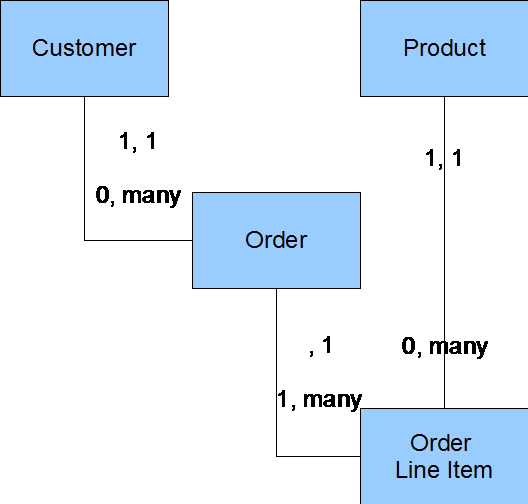
Syntax Rules for an Entity Relationship Diagram: An Entity Relationship Diagram Sample: Use this link: https://docs.google.com/drawings/d/1keA4BzVCJXcUoNWDw7-0pIrQ7AsB5CgavjWR7P5Wyrg/edit?hl=en_US (may have to paste into a browser) Business Rules derived from this sample are: It is also interesting to note that since there is no relationship between Customer and Product there are no Business Rules that can be derived betweenContinue reading “Syntax of an ERD – Entity Relationship Diagram”
 The Path To Inkc